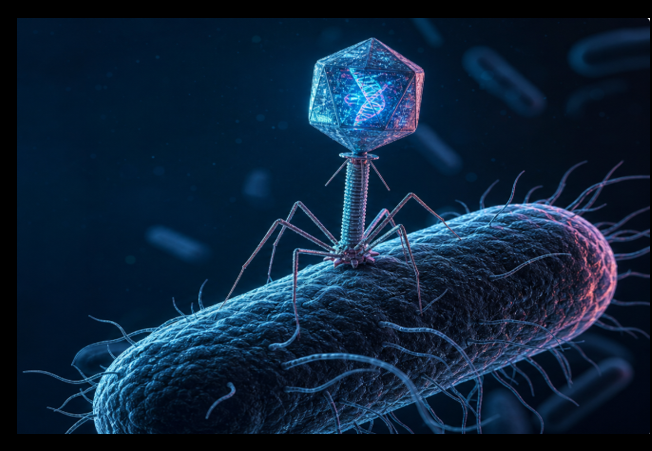

Artificial intelligence has moved beyond generating essays, images, and funny animal videos. Scientists have now used it to design complete, functional viruses with genomes that have never appeared in nature, which may or may not be a good thing… depending on how this knowledge is used.
A Stanford University-led team used generative AI models trained on millions of genomes to create bacteriophages, viruses that infect and kill bacteria such as E. coli. According to the new study published in Science, several of the AI-designed phages were not only viable but capable of reproducing inside their bacterial hosts.
In a nutshell, the researchers used genome language models, Evo 1 and Evo 2, to generate complete bacteriophage genomes modeled on a particular family of viruses (ΦX174) known to infect Escherichia coli bacteria.
The models learned from large genomic datasets and were guided by what was already known about the ΦX174 genetic sequence, helping the models produce sequences that were evolutionarily plausible rather than merely random DNA. The team synthesized selected AI-generated genomes and introduced them into E. coli, yielding 16 novel and viable phages.
The study demonstrates that AI can design functional viral genomes while retaining the interdependent genetic features needed for a virus to reproduce.
Experimental testing yielded 16 phages with diverse fitness profiles in laboratory conditions. Cryo–electron microscopy confirmed that a generated phage utilizes an evolutionarily distant DNA packaging protein in its capsid. A cocktail of generated phages rapidly overcomes ΦX174-resistant Escherichia coli strains, demonstrating a path toward artificial intelligence–generated phage therapies against rapidly evolving bacterial pathogens. This work provides a blueprint for the design of diverse synthetic bacteriophages and useful biological systems at the genome scale.
One of the paper’s authors notes that this has significant potential for use in medicine. In an era where antibiotic resistance is becoming a significant health issue, this innovation can help generate new, targeted drugs.
Stanford chemical engineer Dr. Brian Hie said his team’s work could help inform future medicines aimed at treating drug-resistant bacteria using bacteriophages, viruses that infect and kill bacteria.
“If the bacteria gain resistance to a single phage, it’s game over for the medication,” Hie told the Stanford website on Thursday. “But if you have multiple genetically distinct phages in a mixture, it would be harder for the bacteria to develop resistance to the entire cocktail.”
As I have discussed previously, antibiotic resistance has become an increasing concern. This spring, I reported that members of Congress proposed the Pioneering Antimicrobial Subscriptions to End Upsurging Resistance (PASTEUR) Act, which includes subscription-style federal payments and stewardship programs to incentivize development and responsible use of new antibiotics and antifungals.
The Stanford team reportedly followed appropriate biosecurity protocol. However, some in the field note there are significant biosafety ramifications in this approach.
The Stanford researchers took a number of safety precautions while carrying out their experiment, such as excluding viruses that could infect humans and animals from their models’ training data, carrying out their experiment in a secure lab, and selecting the ΦX174 bacteriophage for their models to emulate because it can only attack E. coli.
But while [Dr Moritz Hanke of the Johns Hopkins University’s Center for Health Security] a praised the team for taking those precautions, he also pointed out there was no requirement for them to do so and no guarantee future users of the technology would be as careful.
There is currently a “huge disconnect” between the pace of science and the pace of accompanying regulations, he told The New York Times.
The Stanford researchers have also made Evo 2 freely available to the public, suggesting the risk to the public is offset by the benefit of “having tools like Evo 2 to address existing natural pathogens”.
The Stanford team’s achievement is a genuine scientific milestone, but it lands squarely in the ethical territory Ian Malcolm warned about in Jurassic Park: “Your scientists were so preoccupied with whether or not they could, they didn’t stop to think if they should.”
AI-designed phages capable of defeating antibiotic-resistant bacteria could save countless lives, true. Yet the same generative models that produced them place viral genome design within reach of anyone with the right dataset and computing power, but perhaps with less concern about health and safety.
If the experience with COVID has taught us anything, it is that frankenviruses can escape containment.
While biosecurity experts note that the Stanford team’s precautions, excluding human and animal pathogens from training data, working in a secure lab, and targeting only an E. coli-specific phage, were voluntary rather than mandated, it must be noted that nothing obligates future users to follow the same restraint.
That gap between what the technology now permits and what oversight currently requires is the crux of the concern; regulation is not keeping pace with the science, and open access to tools like Evo 2 amplifies both its promise and potential dangers. Whether this breakthrough becomes a foundation for next-generation phage therapies or a cautionary tale will depend less on what AI can design and more on who uses this knowledge and how.
Donations tax deductible
to the full extent allowed by law.